
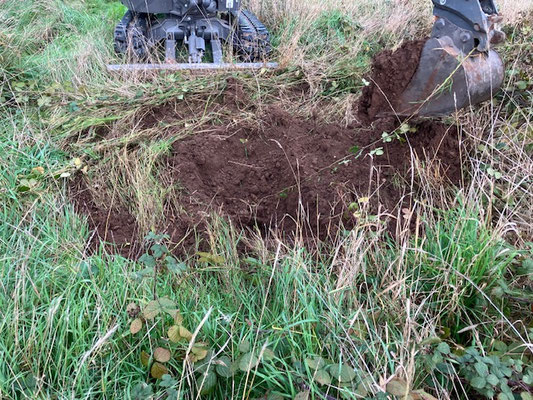
On many development sites, historic soil bunds are often left on the perimeter with no clear records of their provenance. They may have been formed from site strip arisings, material imported temporarily during earlier works, or legacy stockpiles from previous operators. Before any re-use plan is confirmed – especially if the scheme intends to re-grade the site, create landscape features, or rationalise levels – a structured investigation into the bund material is essential. This is not simply a geotechnical exercise; it has environmental, regulatory and cost implications.
The first stage is to characterise the material chemically. A typical approach is to undertake a targeted investigation using trial pits, grab samples and basic classification testing (moisture, PSD, Atterberg). But alongside this, Waste Acceptance Criteria (WAC) testing is usually commissioned. The point of WAC is not to prove that material is “contaminated” or “clean” – rather, it is to determine whether the material would be classified as inert, non-hazardous or hazardous if it were to be disposed of. Developers need this because re-use is always assessed against a baseline of “what is the worst-case disposal cost?”. If a bund turns out to be non-hazardous rather than inert – that can easily swing a re-use decision by six figures on a medium-sized scheme.
Once the baseline characterisation is known, the next phase is to examine whether the bund can be retained on site legitimately. This is where the CL:AIRE Definition of Waste: Code of Practice (DoWCoP) comes in. CL:AIRE DoWCoP provides a mechanism to classify excavated material as a “product” rather than a “waste”, as long as certain conditions are met – including demonstrating suitability for its intended use, creation of a Materials Management Plan (MMP), and appointment of a Qualified Person (QP). For historic bunds, this means the bund material can, in principle, be re-profiled and placed within the site as engineering fill or landscape fill, without triggering waste permitting or transfer to landfill – provided the MMP demonstrates compliance and verification is undertaken.
The final stage is integrating the data into earthworks design. Geotechnical classification testing determines which acceptability classes the material can fall into – for example, whether it meets Series 600 compaction requirements for general fill, or whether it is better suited to sub-formation layer only. Designers can then assign the material to cut-and-fill zones, slope buttressing, bund optimisation or screening mounds. At this point, the geotechnical and environmental streams of the investigation converge: WAC defines the regulatory baseline, CL:AIRE enables lawful re-use, and design determines whether the material provides engineering value.
Done well, this three-phase approach converts an uncertain liability into a defined asset – keeping soil on site, reducing importation, and delivering more sustainable earthworks outcomes.
Here at Geo-Integrity we have years of expertise in all three stages and have undertaken these types of investigation numerous times. If you need assistance with a site please contact us by email or phone 01280 816409

Write a comment