
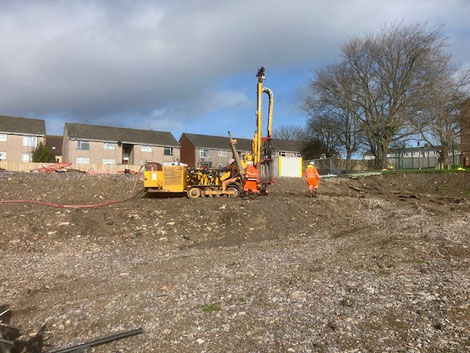
A site investigation was recently undertaken for a good client on land underlain by the South Wales Coal Measures to assess the potential presence of historic shallow mine workings, specifically bell pits, and to identify any associated voided or unstable ground within coal seams; following a previous investigation which found thick coal seams and minor evidence of workings on site.
The investigation was required to inform future development and ensure that any risks related to historical coal extraction were properly identified and managed; so that NHBC sign off could be achieved and the development could be undertaken to the client's usual high standard.
The Bristol area has a long history of small-scale and industrial coal mining, and early workings such as bell pits can present significant geotechnical and safety hazards due to the possibility of collapse, subsidence, and the presence of ground gases.
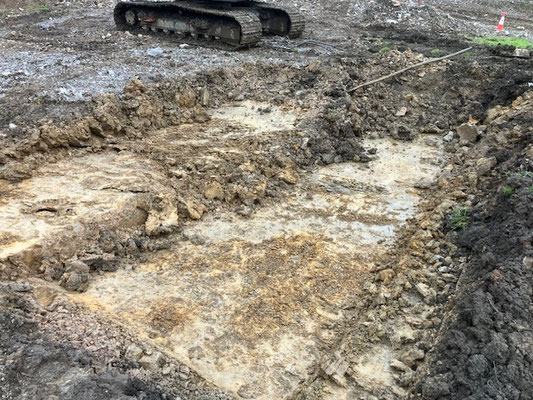
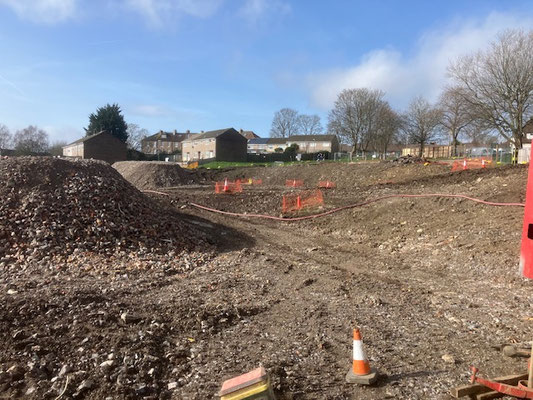
The initial phase of the investigation comprised a programme of trial trenching across areas considered to have the highest potential for historic shallow mining activity. Trial trenches were excavated using a tracked 360-degree excavator under the supervision of an engineering geologist. The trenches allowed direct observation of near-surface ground conditions and enabled the identification of any disturbed strata, backfilled shafts, or anomalous materials that might indicate the presence of a former bell pit entrance. Particular attention was given to identifying circular or sub-circular zones of disturbed ground, changes in soil colour or texture, and the presence of anthropogenic backfill materials such as brick fragments, coal waste, or loose rubble. Excavated faces were logged in accordance with standard geotechnical procedures, and photographic records were taken.
To supplement the trenching works, a series of rotary probe holes were drilled across the site. Rotary probing is particularly suited to the investigation of shallow mine workings as it allows rapid penetration of superficial deposits and bedrock while identifying zones of reduced resistance that may indicate cavities or poorly consolidated backfill. The probe holes were advanced to depths sufficient to intersect the target coal seams where possible. During drilling, the rate of penetration and drill string behaviour were carefully monitored. Any sudden loss of drilling resistance, drop in drill rods, or absence of cuttings was recorded as a potential indication of a void or weakened zone associated with historical mining activity.
Following the intrusive investigation of ground conditions, ground gas monitoring infrastructure was installed using window sampling boreholes. These boreholes were advanced using a window sampling rig to appropriate depths within the superficial deposits or upper bedrock. Gas monitoring standpipes were installed and sealed to allow periodic measurement of gases that may be associated with coal measures strata, including methane, carbon dioxide, and oxygen levels. Monitoring was undertaken using calibrated gas detection equipment in accordance with recognised guidance for ground gas risk assessment.
The purpose of the gas monitoring was to establish baseline gas concentrations and to determine whether the historic coal measures environment or any potential mine workings could generate hazardous ground gases. Data collected from several monitoring visits provided an indication of gas regimes and helped determine whether any protective measures would be required in future development.
Overall, the combined use of trial trenches, rotary probe holes, and window sampling gas monitoring boreholes provided a comprehensive approach to identifying potential bell pit entrances, assessing the presence of voided ground within coal seams, and evaluating associated ground gas risks within the South Wales Coal Measures underlying the site.
If you have a site located in a Development High Risk Area as designated by the Mining Remediation Authority (the old Coal Authority) and you require assitance with planning and design please contact us on this email or phone on 01280 816409

Write a comment